
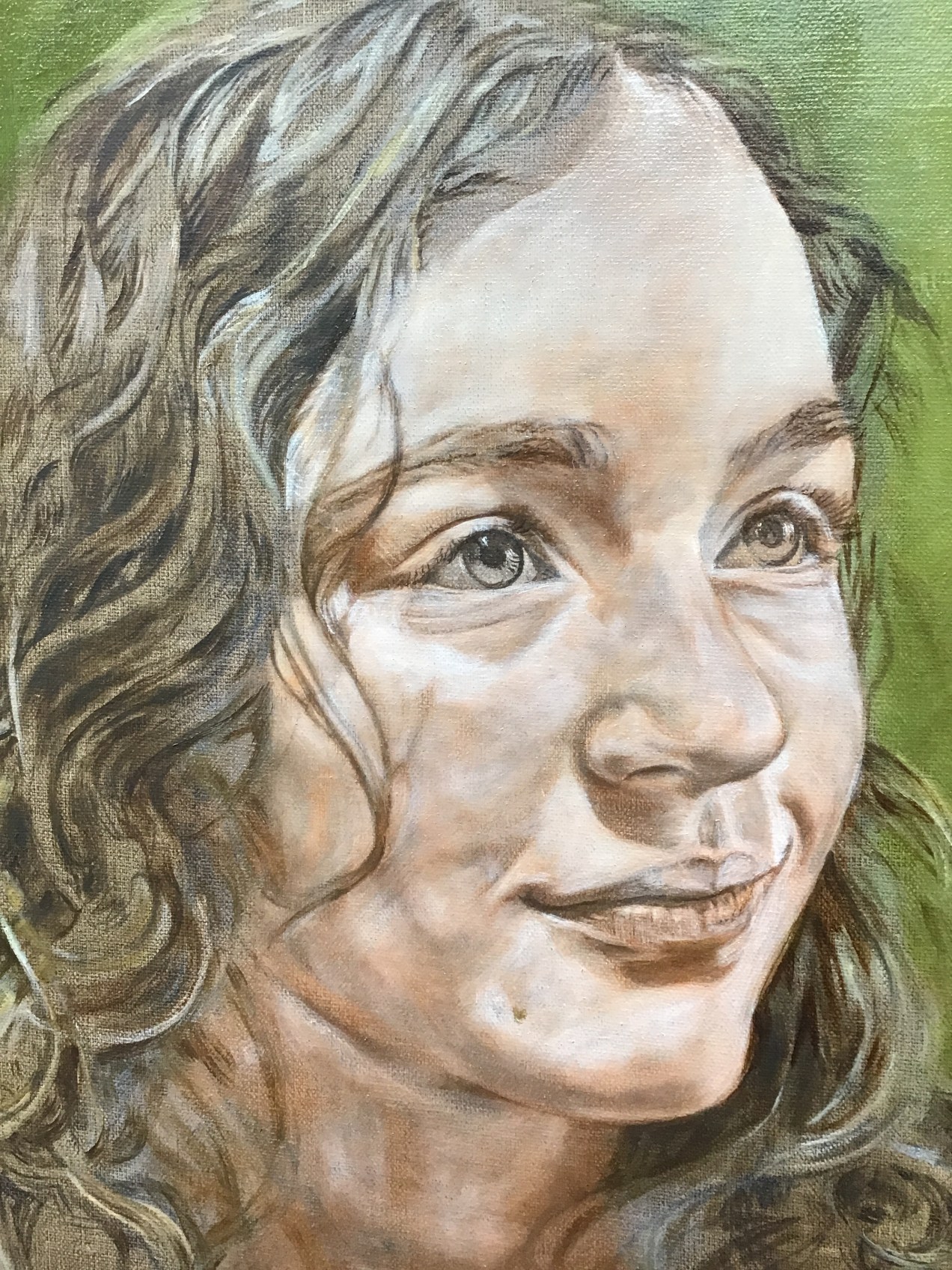
Ok, my post disappeared. I will try again. These layers will, believe it or not, add up to a supple and beautiful flesh. After this dries, I will put in a few details, such as enhancing the shape of the flesh around the eyes and maybe a glaze of color to show thru the next flesh layer. Can you tell i moved the mole? Also, I put some dark flesh tone under the lip to enhance the fullness there. I have no more time. I must go. i hope you enjoy these layers. It goes better if you dont feel pressured to do too much at once. Hugs, Diana
Monthly Archives: April 2022

A second flesh layer
Today I began by deepening and desaturating the background color. The colored egg green was too immature for this sophisticated portrait but i use a color for the under layer that will influence the final layer. This must be applied sometimes in an inconvenient timing but it needs to dry before the hair around the outer edge. Now i scrubbed in a transparent but still rich hue of flesh, layering more color in the deeper areas of flesh and less heavily in the lighter areas. Of course, this is buffed to a sheen before carefully painting in a mixture of titanium white, flake white and naples yellow. In this image, i have smoothed and then buffed the areas as I go, to maintain a level of control. Keep in mind, what we achieve in these early layers is not the finished product. The supple skin will be built as we go. Try to make sure that what you accomplish in a layer is correct to the best degree although not finished. Each layer after will add more correctness and more dimension. I will try to post another image when I finish today’s work. Diana
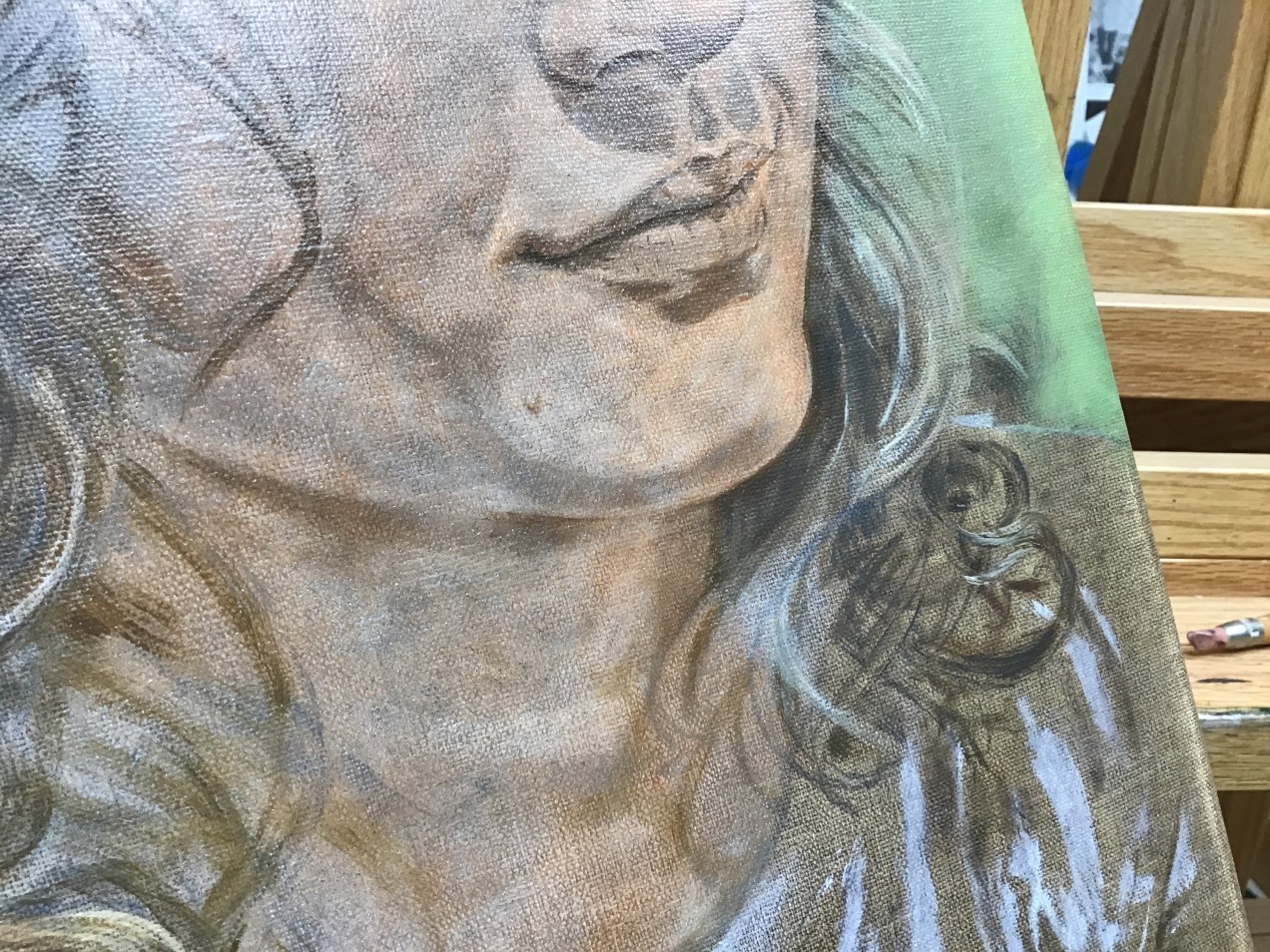
Beginning the flesh
This may feel like a difficult task. We must remember, it is a first layer. After you apply the flesh, mixed half and half with gel, be sure it is spread into the weave of the canvas evenly and then use a fan brush to buff it to a high gloss surface. Now you must decide if the brights are white, yellow, or some other shade. I often use Titanium, flake or lead white, Naples Yellow, or a blend of these,(for Caucasian skin color and sometimes even for darker skinned people.)Apply them by following the light patterns you see on the sitter or reference material. Place the paint with the best sable brush if you have it, or a synthetic. Make the first layer as accurate as you can, smoothing the paint with your soft brush. Then, with a very soft but firm or bouncy fan brush, buff this flesh. This is where you will answer your question, ’How much paint?’. You will learn from practice just how much to apply in each layer so that it can still receive a buffed surface. THE FIRST LAYERS OF FLESH ALWAYS LOOK BLOTCHY! In this method, each layer will enhance the suppleness and realistic look of the skin. Many students are content with two or three layers. Later they comment how real the skin on my portraits looks. This is achieved by multiple layers of transparent flesh. You will learn later to add the richer tones of the skin surface with transparent glazes. These colors may be introduced earlier but each painting sort of sets its own pace. Remember two things; continue to make whatever corrections are necessary and, two, ’if it doesn’t look right, it is just not finished!’. Enjoy spring. Diana

Did someone say ’easy’?
Yes, sometimes I feel frustrated! I love this whole process but when you put in the hours and only have a few hairs to show for it, even I feel overwhelmed. But then I step back and look at the overall progress! That is today’s lesson! Don’t forget to step back and congratulate yourself for making it this far! Don’t just see what you have in front of you. Look at what you have accomplished as a journey and envision where you are headed. I cant imagine painting a portrait if I could not see ahead. Maybe that is what makes the difference between who chooses to paint portraits and who does not. If you cannot see ahead, it could be difficult to continue this journey. I don’t believe that should stop you, though. There have been plenty of times when I did not know what would be my next step. If you get to one of these places, take the steps slowly and don’t allow yourself to blunder forward. Rest, think, pray, and try something. If you don’t go too far, you can always wipe off or paint over. The point, I suppose, is to enjoy the journey, the scenery and experience the lesson. I can see where I am going and I don’t want to hurry to get there. I sincerely hope you are learning something as you make each attempt on this artistic road. Don’t be hard on yourself. I will do the same. Diana

Quick post
I put another layer on the background and then reworked some hair placements, which added a little dark color. it seems like I have worked a long day with hardly anything to show for it. ”Mama said there’d be days like this !” Sorry, gotta run!

Today’s work
Sometimes only the artist can see forward to the final vision. This likeness just turned on for the viewer. i knew it was in there. It isn’t 100% guaranteed but when it shows up this early, an artist has a pretty good feeling. I didn’t have any more time today but I encourage my students to do less, then study, then go back to do another pass. Hugs, Diana
Do you want to capture likeness?
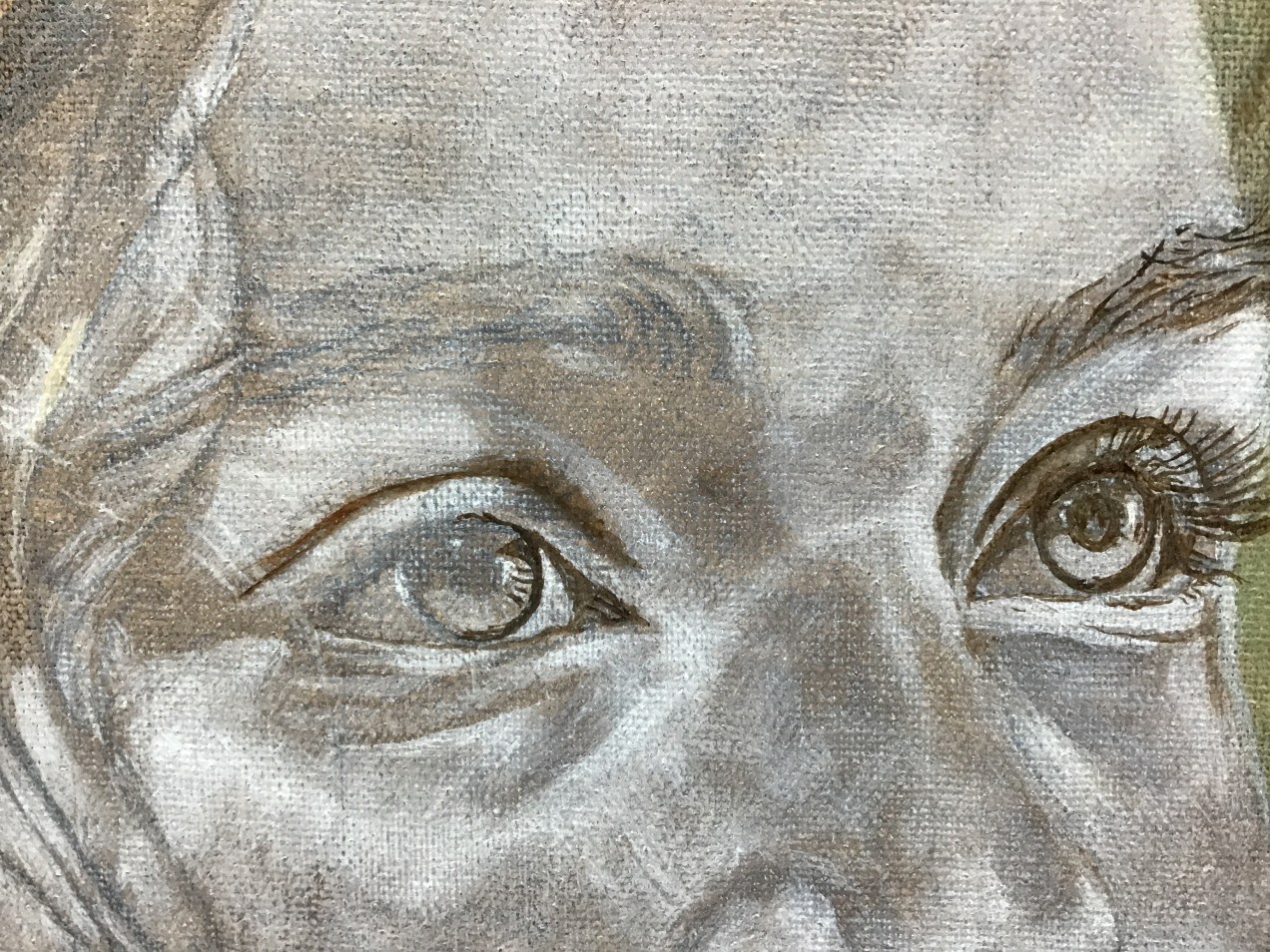
Pay attention to this if you do. What i mean by that is these steps are vital to implement and get right if you are trying to improve your ability to capture likeness and even spirit and mood and personality. Look closely. Remember that first we painted the structure or skeleton of the portrait, the planes and shadows. Then we marked the brights. After it all dried, we overlayed it all with ’skin’ -a half paste of white and Grumbacher gel. Now we begin to perfect the details. You will see the right eye has been refined with shadow and detail. Notice closely how the eye on the left is only partially refined. i took the photo now to help you see the difference. i am using a flesh colored paint with a little neutral dark in it. I am using a fine small round brush to mark hair and thin edges. When this dries, i will probably do a second layer of ’skin’ and then make more refinements. The more thin transparent layers we use, the more supple and real the skin will look. Have fun. Diana
Be sure you see all these, in order if possible
When I was reviewing my posts, the one entitled ’a layer of skin’ did not show up as I scrolled. But, the info listed says it is there. i hope it is in your view because it is a very important step in this process

Finesse
This is where the work takes finesse. The artist must train their eye to see patterns of light and shadow. It is one thing to be able to see them and another to be able to paint them accurately. Also, remember, it is a matter of the style and a question of the effect you wish to achieve. I am going for realism and an accurate likeness.
i am using the best sable brush I can get, soft with a good edge and point. The image I chose is unfinished in order to help you see the method of application. Of course you will have to study this still photo very carefully to notice the soft light in the shadows of the Eye lids and under the nose. Also you must understand that every layer will adjust this shadowing and light. If you don’t perfect it on the first pass, it will be refined as you go.
This may be the last post until after the holy days. Till then, Shalom. Diana
A layer of skin
We have thus far created a three dimensional look by using the light and structure. We have achieved our likeness and are satisfied with the results. Even so, the painting so far is monochromatic and basic. The image is accurate but not realistic. in teaching myself how to paint a portrait, I came to understand that flesh and bones also need to be covered with skin. My painted figures did not take that step toward realism until I had gained this knowledge. In the first image i have randomly applied a mixture of titanium white, flake white and an equal amount of Grumbacher Gel. Then i use a soft old brush to work it into the weave of the canvas until the paint is evenly applied. if i am able to load the next photo, it will show how i have used a soft fan brush to smooth out the paint layer, removing all but a trace and then buffing with the brush until the surface has a sheen on it. This is the buffing process we will use between every layer when painting the flesh parts of the portraits. these two images are in reverse order but at least they are both here.

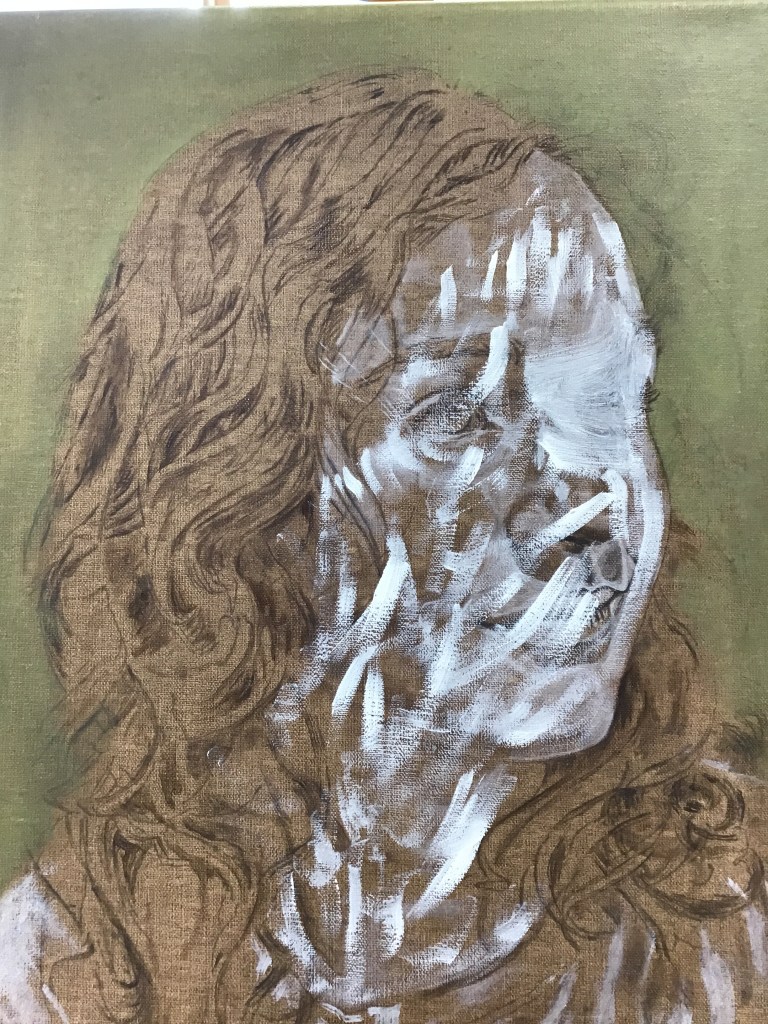

Just a little time to work
Well, I was not expecting to do any work on Sophia today because the features on her face should be thoroughly dry before the next step. As I studied everything on the canvas, (always an important thing since it helps the artist learn), i realized i could add some landmarks in the shirt and put a first coat on the background. The old masters studied drapery, folds and clothing for long periods as apprentices before they were allowed to move on with other painting. I approach fabric just as most other things; applying the light and shadows first. You can buff or use a tissue to blot so that you don’t leave too much paint on the surface. Think of this as a place marker or a map to help you lay out the patterns of wrinkles. I enjoy painting patterns, on fabric, hair, water, etc. Be warry of choosing a bright color for a background. Sophie’s skin tones are ivory and pink. I chose a neutral green for the background. I mixed cadmium yellow and phthalo blue which made a beautiful bright green, way too bright or intense. I softened it a little with white, still too bright! Now, try to remember this next part! The color, very pretty, was TOO INTENSE and it needed DESATURATED. I didn’t want the color changed. I only wanted the brightness brought down. So, I added some of my original dark. you could probably use black or gray. Don’t be surprised if at first it looks like mud. Spread it on, making it darker and lighter where needed. You will learn from practice how this desaturated color will look good without overpowering the image. we find our true difficulties arise from going to bright, dark or heavy on our first move. That is all for today. I hope these suggestions and instructions are helpful. Remember, you can always refer to them as needed. Hugs, Diana
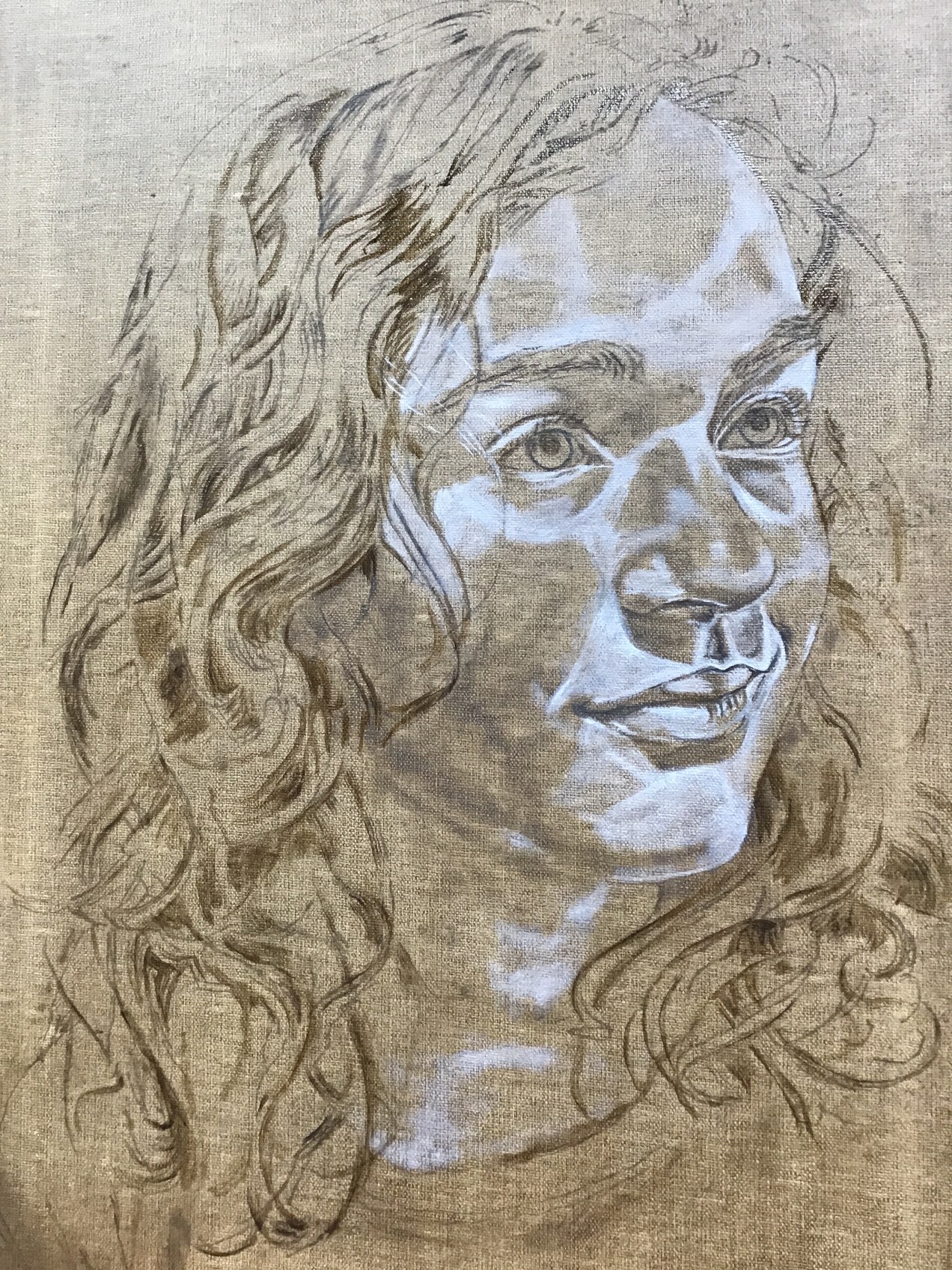
First adjustments (corrections)
My students have heard me say, ”portrait painting is the art of correcting”. It just makes sense. if we have the hand and eye to get it right with the first mark, then we should do well from there. Most of us would not be doing this if we did not have the patience and the ability to see minute details. Making a good likeness is usually possible only when we are willing to constantly examine our reference for the tiny details that make us individuals.
Today, I first added tiny adjustments to the brights. They are so small, I doubt you will be able to find them. Next, using the same dark, i marked ONLY the main shapes and deep darks spots of the hair patterns. The marks should not be bold. Even though the color is the same dark that I used for the undercoat, I stress that the marks should be transparent. This is done by the pressure used, not so much the amount of paint or intensity of color. This turns out to be important as we go on to other steps, mostly because we don’t want to fight the dark paint when adding color. Forgive me if I repeat instructions. Learning portraits can be complicated and it is good to be reminded. Also be prepared to adapt and do things in different ways. We must make these decisions based on each situation and every variable involved. I do hope these examples are useful for you. Hugs, Diana

Brights
Every step is important, yes, but with a portrait, it is vital to capture a likeness. So, the artist must learn that the features are emphasized by the effect of light on the shapes of bones and muscles in our face. first we transfer the drawing, then we use the same transparent but dark paint to soften those lines and emphasize both shadowed areas and also certain features like folds, creases and deep places. Always buff, which is done using a soft fan brush lightly feathering over the top of the wet paint in order to remove brush marks and prepare the surface for the next layer. There are other methods of portrait painting and you must decide for yourself which you like best. i have found this one gives a realistic and pleasing finish to the portrait. As you refer to these posts, teach yourself to study closely. On this image, it may seem as though the entire face is beginning to look painted. if you study closely, you will see that it is simply and sparingly painted, first with the darks and now, minimally with the brights. please understand that the more precise you are in this stage, the less difficulty you will have as you proceed. it would be possible to begin the background at this time or work on the clothing, or even some of the hair marks. But, since i am attempting to teach you precision and method, I am encouraging you to not move ahead too fast, rather engrain in your mind the WAY to proceed so as not to end up frustrated and overwhelmed with a feeling of being lost, so to speak. Later, after you are more sure of the process, then you will have the confidence to overlap the steps and work at your own speed. You all have expressed the desire to improve your skills. Every thing I apply in my work was learned from observation, thought and practice. Discipline your artistic process and incorporate your own ideas into other projects. Keep the learning process in a separate compartment of your brain at least until you are finished with the project you have begun, that is, understanding this particular process. see you at the next step. Diana
An extra note to my class
Hi! now that i am not working in my studio or in a hurry to quit and cook for our evening meal, i thought i would add a little more information for you. This stage where the image is transferred onto the canvas but no real work has begun is one of the most exciting stages for me. the reason is because there is so much potential and i have not yet messed anything up! If you look over the transferred image, you can see that there is very little paint on the canvas but more importantly, very little information is there; a drawing, a small amount of shadow and form, and thin, transparent work. Think about it. This is the first layer but it is barely visible. Consider too that this is the first layer of darks. since i was short on time, i did not do the darks in the hair. when i get to that, i will try to emphasize the sort of follow the dots method I use in this. I wont paint a lot of strands, instead, i will mark some of the deep hairs that are in deep shadow, which form shapes in the hair patterns. Then i will begin to put the hair puzzle together. in general, though, my next step will be brights. i will be as stingy with painting areas of brights as i am with darks. This is because i do not want big table top areas of flat white. The face of every human is made up of muscles and planes and bones and turning toward and also away from the light. it is all this which makes up the likenesses we paint..I find it fascinating and challenging. it will be our mission to learn this concept that a bright has edges that fade and darken, not flat areas of all one brightness. it is easier at first to paint only the very brightest (holding the truly brightest for highlights at the end). it will be easier to show you how adding the layer of skin (half paste of gell and white) will begin to modulate the brights and darks allowing the structure of the skeleton to form the likeness by the use of light. Hope you are all feeling better. See you Tuesday. Diana
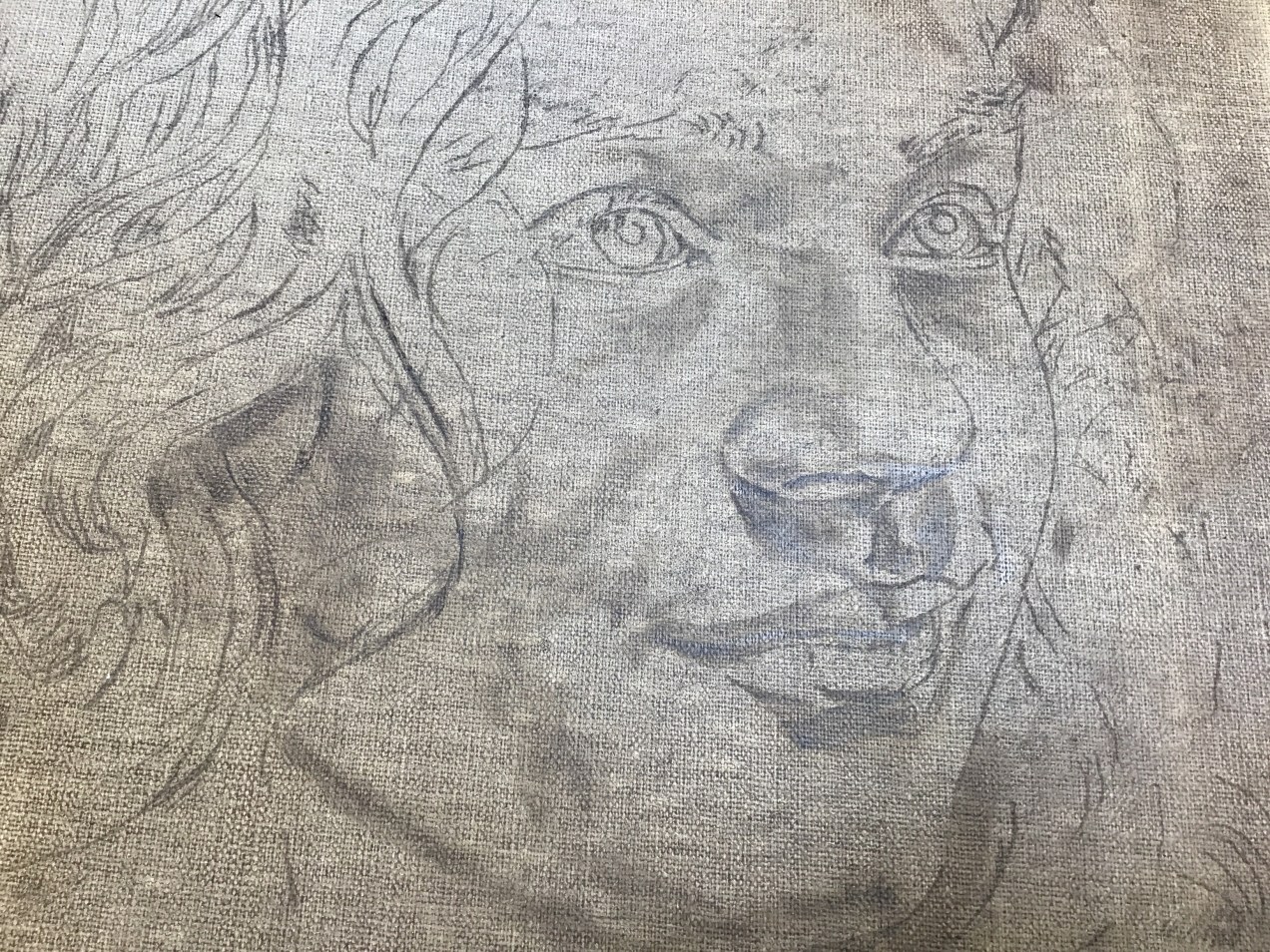
I dont like hurrying
This stage is so important. Of course it is the end of the day, i need to go cook supper, but i still want to do these steps correctly. i cant stop and wait till tomorrow because it is important to soften these shadows and features while paint is still wet. i want you to understand that it is easier to work with soft forms rather than lines. This is the best time to begin this process. With this technique, I go back and forth between darks, not too dark, and what I call brights. at this stage, i have transferred the drawing. i used the same paint as the under layer but since the canvas was rubbed down, it looks lighter. Now, we are going to establish some of the form and shadows, but do NOT make the mistake of painting darkly or with heavy coloring in. Any paint will need to be transparent and thinly applied. you can see i painted only small areas and lightly. Now i use a fan brush to softly buff the surface. This removes the brush strokes and readies the surface for the next process.
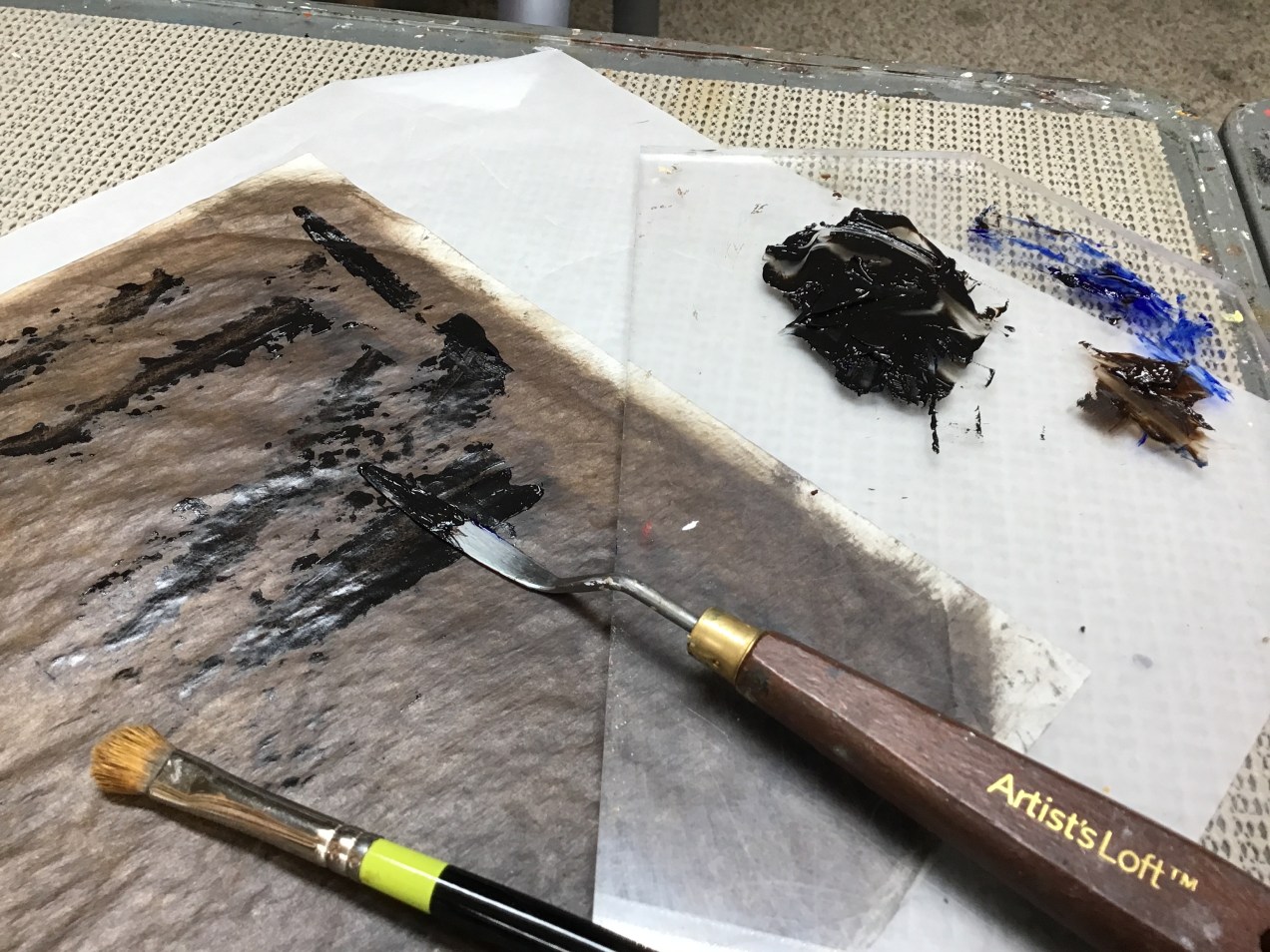
Preparing for transfer
This may seem strange but i use a medium size sheet of tracing paper. Mix the same color which was used for the imprimatura or first layer. Spread a very thin layer onto the tracing paper. be sure there is not too much paint or it will cause messy dots all over the canvas. place this paint side down and put your image on top. Use whatever works to go over the drawing, being sure not to miss anything. Always be sure to mark your image and canvas in order to realign it if necessary. i will try to take another photo for this demo.


Students request more info
I thought I would get back to my art sooner. I ask your indulgence as I find it more challenging than I thought to settle back into a routine after the death of our grand daughter. I began this week with an early morning funeral mass for a friend and two weeks ago a long time friend and neighbor completed her time here with us as well. My sympathies go out to you also because this is happening more than we realize.
I have continued weekly classes for students who desire more intense study, or even those who are learning the basics. These people are talented artists who have just not learned portrait painting. They are doing great but crave more detailed information. I will do my best to post a detailed description of each step as I proceed with my grand daughter, Sophie’s eleven year old portrait. It will be a slow process because of at least two events. One is Passover which I observe and also will have visitors during this time. The other is the big show at SAMA, Loretto. We have already delivered thirty two paintings to the SAMA museum on the campus of St. Francis University. It will be a busy time.
A photo will accompany this blog. It is to show the linen panel, actually a 12×16 oil primed stretched linen canvas. my students often have trouble doing an imprimatura, which is just a toned oil layer, brushed on and wiped down with paper towels. I used burnt umber mixture withultramarine blue until the color was quite dark. Then as i wipe it down, the color is usually a warm brown. My students often end up with a blotchy black that is hard to work with. It absorbs into the canvas and also wants to resist the next paint layers. it may be because of high pigmented paint or because of lesser grade canvas. I cannot be sure. Aim for something similar to what you see here. As for the image used, I get the best results from a simple image with good lighting. It is possible to draw a good likeness freehand if you have a lot of practice at this. If you decide to use a photo reference, you must study that on your own and understand the complications so you overcome or avoid them. Try to hear this clearly; the image must be a precise image but not necessarily detailed. It is most important to have the measurements precise. You will see that I have used a grid to aid in correct likeness. I choose this because it saves time, a valuable comodity, and it can be very precise if done correctly. Whatever method you use, it is important to make every mark in the drawing as correct as possible. A simple drawing works for me and I study it to make corrections before i transfer it. I will post another image and more instructions as I go.
 Diana Williams Portraits