Blog

A note fyi

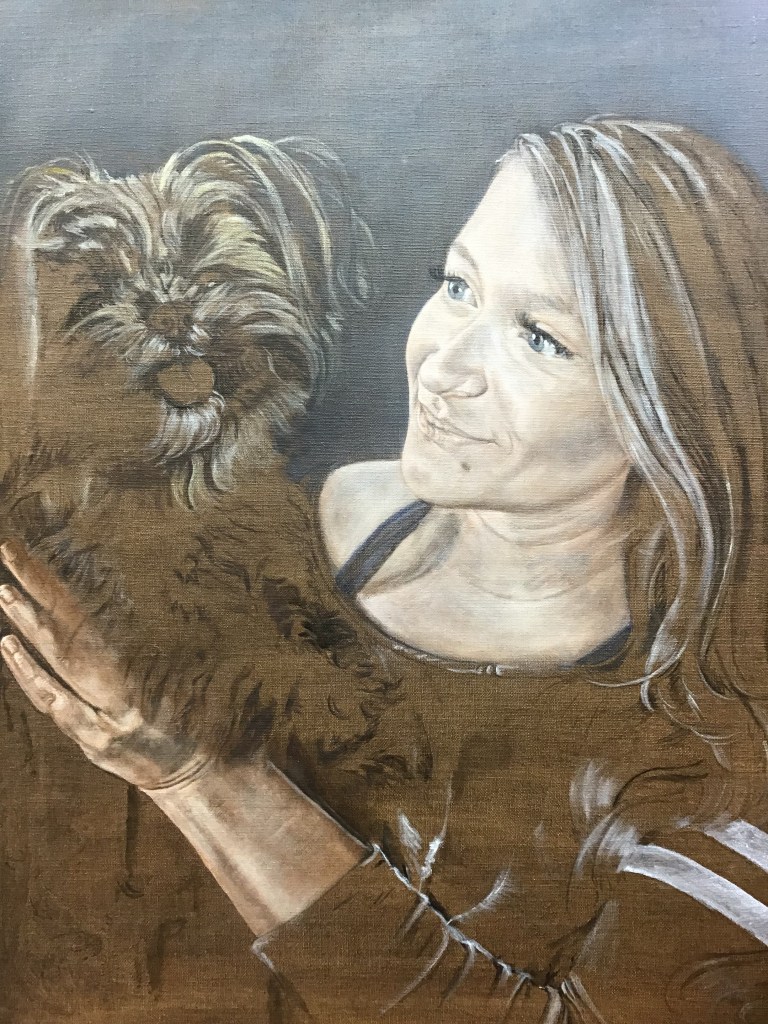
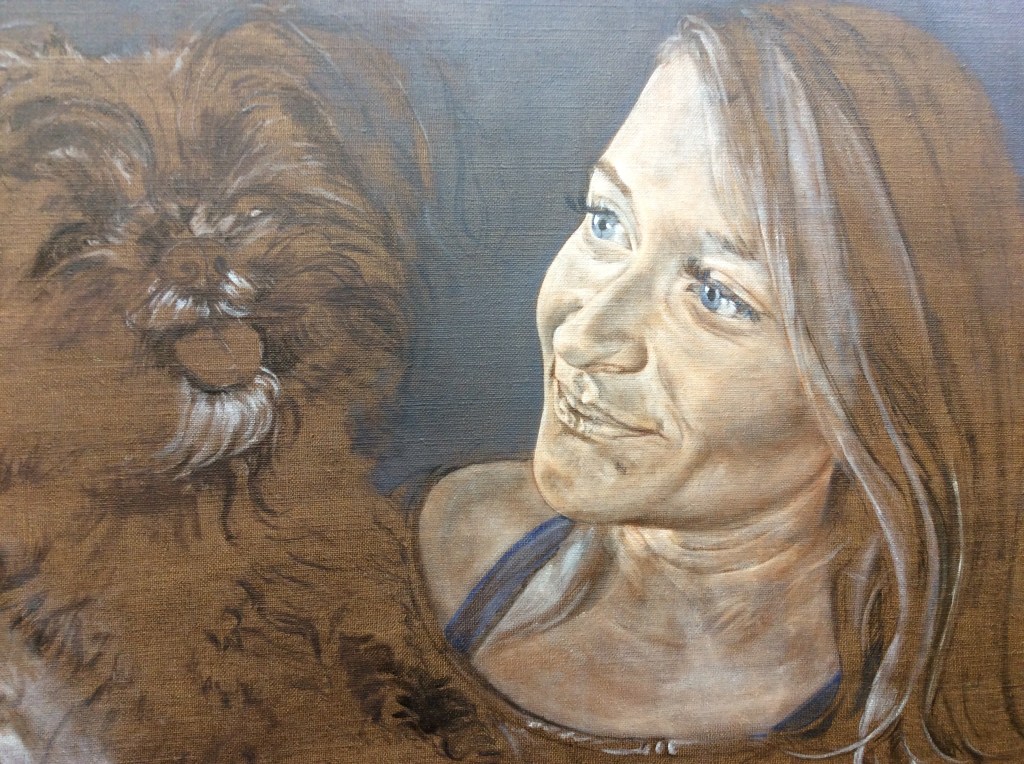
Actually, this is a note to myself as well. Here is an image of Sam which I have done totally with a sketch I made with a graph. I knew it Should be almost exact but something didn’t seem right. I used a piece of tracing paper to double check the image. I positioned the tracing image and used a flesh colored paint to transfer the second image over the first. As you can see, if you look closely, the only thing off is the bottom of the ears and the bottom left side of face. I took another photo after touching up the under layer. Now, with just those minute tweaks, this likeness should be good.
Standard
Blog

Today’s layer

Each layer adds dimension, likeness and depth of color. The artist must understand that the build up of these transparent layers is what creates supple and alive looking flesh. We must learn how to build slowly. Instead of thinking of it as having patience, I am thankful I do not have to perfect the portrait the first pass. Often a subject has blues and greens and yellows in their skin or reflected off the skin surface. It takes skill and experience to know when and how to use these colors. Here, my granddaughter presents her lovely ivory and blush tones. There is some hint of yellow in the forehead but not much. When today’s pass is dry, I will take a small amount of the flesh tone, I will add a touch of quinacradone magenta and an equal portion of gel with maybe a drop of linseed oil. These will be mixed well with a pallet knife and spread in an even layer over the flesh. Now, I use a soft fan or mop brush to buff this surface to a sheen. Next, I touch my soft sable brush to the yellow ochre and gently apply a little where I think it should be. Now I use my white to redo the brights. This picks up the other colors and draws them over the flesh in minute amounts. You will begin to see your flesh colors coming to the hue you are looking for. It is better to build slowly to these rich tones than to be startled by a heavy application of color that will never look natural.
Standard
Blog

A second thought for today.

Yes, I have a method, so, you would think this process would follow along the routine steps and I would never get lost. WRONG! Perhaps I just forget something, or maybe I decide to skip a step, or maybe something just doesn’t seem right. I have messed up so badly at times that my only option is to call the mess I have an under painting and drop back to square one. Then again, maybe I don’t know why something isn’t right. What I want you to think about and understand is that you must trust your ability. And, I believe in a higher power and I ask YAH to intervene. This gets me on the right track and I come to understand what move to make next. Believe me, if your flesh tone looks blotchy, do another layer and then another. Each time you paint this face, you get to know it better. What you may not realize is that your brain is learning how to paint suppleness into the skin. You don’t need a teacher except to help the process move along more quickly. What your brain needs is failure and experience. This is how we were meant to learn. Get the point I am making here, please. Your brain is gaining mastery as you try to figure this out. How else could I have learned. I looked and I tried and failed and began to recognize my own improvement. Don’t give up. I am grateful I kept trying.

Standard
Blog

Refuse to become frustrated.

When working with portraits, it often happens that something doesn’t work the way we want it to. I could name a million examples but let’s just take an obvious one. My students call certain things I say, ‘Dianaisms’. For instance I say, ‘If you get the line of the mouth correct, you capture the likeness.’ Well, that line of the mouth is an illusive feature. If the artist gets this a shade wrong in size, shape or color, it can ruin everything. Artists, no matter what mark you put on canvas, be prepared to adjust it. Study these features thoroughly, not just once, but over and over again. If you cannot make it right while the paint is wet, then let it dry. This way, if you are not happy with the results, wipe them away and try again. Trust your vision, that of your eyes and your heart. Do your best to please your sitter but remember that the artist creates. We are not cameras. We are attempting to show others the beauty that we see. One of the great portrait masters was eventually tired of criticism from his clients. He stated that he would rather paint dogs!
Standard
Blog

Beginning the flesh layers

I paint portraits in a different way. I don’t use color strings. I mix a flesh tone in a medium range but it actually looks sort of like the color of a Teracota pot, then I dilute it with Grumbacher Gel to make it transparent. Apply it thinly but evenly over a section of flesh and then sculpt with white to achieve the brights as you did in the first part. This layer always looks blotchy so don’t worry about it being perfect. Every layer will improve the surface and the skin will look supple and alive. Try to improve the likeness with each pass. Keep in mind that light and it’s effects will be the best addition to a good portrait. Without the light, you cannot see the shape or color or expression.
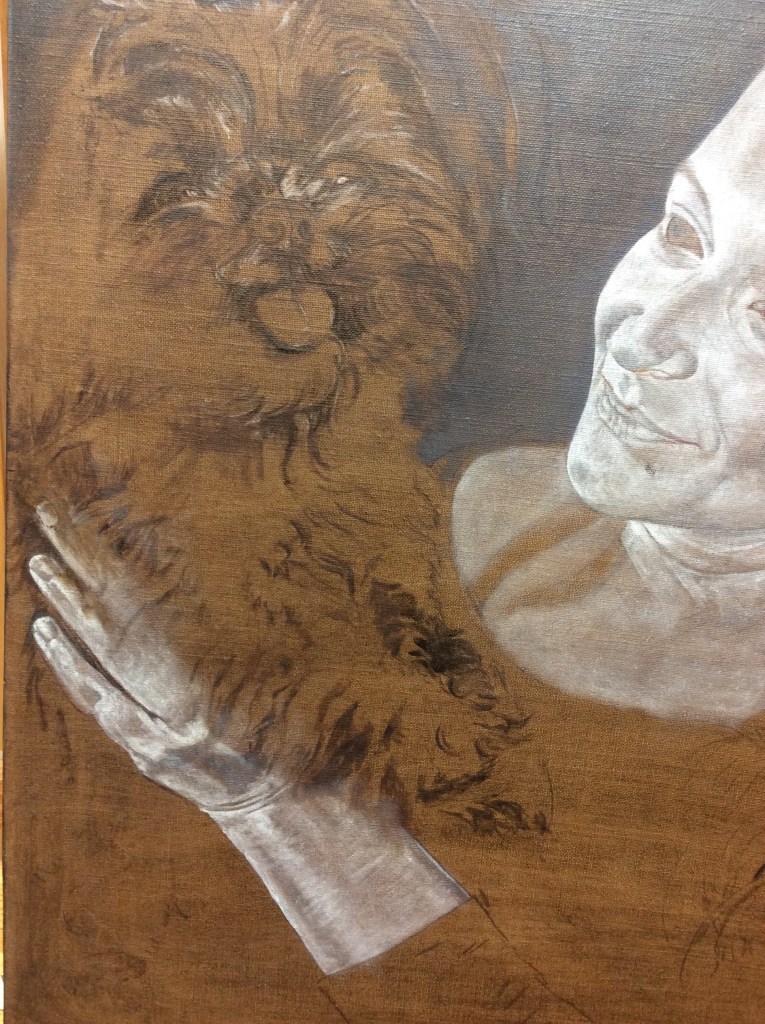
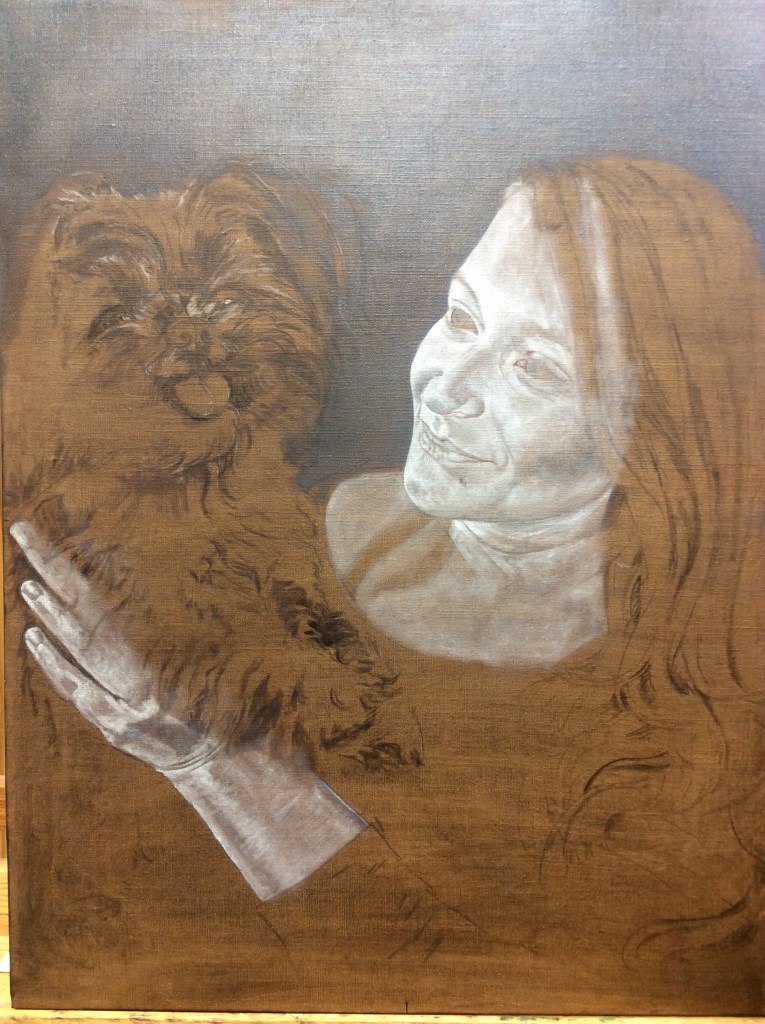
Now that the likeness is more established, I will begin to add darks to bring out some of the details such as wrinkles in fabric, deep bends in body, for instance elbow and fingers, and I will plot all the darks of the hair and the pup’s fur.
Take notice that I have not painted in the eye lashes with thick dark paint. Later when the portrait is almost complete, I will use a transparent dark for the lashes. I always recommend using a transparent dark even for very dark lashes. It just helps make them seem more natural.
People often ask how soon till the portrait is finished? It would take a very long time to list all the work that must still be completed. No one gets it. A puzzle can only be put together one piece at a time and a portrait is sort of like that. Today, I can only put in the next piece or two. How can I ever let you peek into my artistic mind and let you see what must still happen. If I sew a dress, I can show you the pattern, the fabric and explain the steps of putting it together. It is similar with a house or a piece of furniture. But how can a sculptor tell you how to find a body inside the stone? I might be able to tell you the basic steps to a portrait but never explain the finesse necessary to make it a masterpiece!
Standard
Blog

Perfecting the image

I learned a long time ago to spend a lot of time studying the drawing in the early stages of the painting because the adjustments and corrections are easier to make here than later. See if you can tell that the left eye as we look at it, in the earlier images,is too small. I had to study carefully to deterrmine how much change was necessary. It is also very important to get the smile correct as well, in order to capture the likeness. Now these features are the way they should be. For these changes I worked on the dry grisaille underpainting and I also switched from the neutral gray color to the flesh tone. Later there will be several layers of flesh and glazes of pinks or appropriate colors for the person’s skin tones.
Standard
Blog

Painting other areas

Be sure to scroll down to see the beginning of today’s work.
When you come to a place where you cannot do more on an area, often you can go to another area of the painting if it won’t cause difficulty with the work you have just completed. Take notice of the background color in the area of the pup’s ears. The background color must be behind all those separated strands of fur but I certainly don’t want to paint between each strand. If I choose to do this background before the final layer of fur is painted, I can paint right over everything. Then, later, when I apply the last top coat, it will look more three dimensional and the fur will look real! Also observe carefully that I have done more adjustments on the features and skin texture. I tell my students, ‘portrait painting is the art of constantly making corrections.’
When I come back to this in a few days, I will probably add the first layer on the eyes, some color on the clothes, the darks on the hair and the fur and then I will start adding the many layers of flesh tone. A painting this size is often priced beginning at $25,000. Is it any wonder?
Standard
Blog

Beginning again, so it seems.

Yes, once again I use full strength white to enhance the features and brights. Each time I put a layer over another, I make small corrections. It is posssible to do these layers wet but more often it is best to let the current layer dry completely before adding the next one.
Standard
Blog

Look carefully, don’t overlook the small stuff.

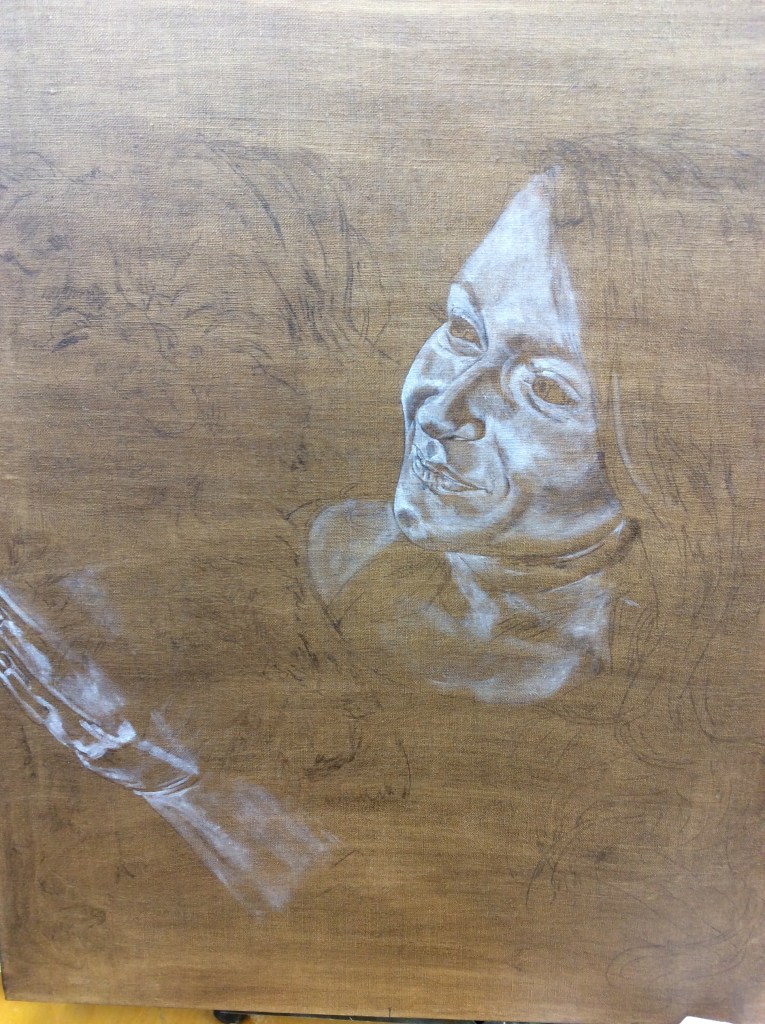
Look at the previous photo from yesterday. On this photo, the flesh has been covered again with the halfpaste mixture, half titanium or flake white and half Grumbacher gel. This obscures the features we hilighted yesterday but, when we buff it well with a soft but firm fan brush, the features appear again, only now they have a layer of skin. These steps are important to achieving a deep and supple skin tone and texture.

Look

Standard
Blog

Tiny refinements

I have worked at least two hours making minute adjustments to the value of skin tone, brights and darks, and to areas that define likeness. I will do this over and over again until I am satisfied that the likeness is good.
Standard
Blog

Half paste and brights

Never begin this step if the layer before it is not totally dry!!!
Here is where the likeness, the spirit and the mood are begun to be captured. This is an important and exciting stage of portrait painting. You must be able to see light patterns and shadow patterns as well. The more refined your ability to paint these patterns, the more precise your work will be. I do not seek to achieve photo realism but I do see beauty in and appreciate realism.
Standard
Blog

First the darks, then the brights.

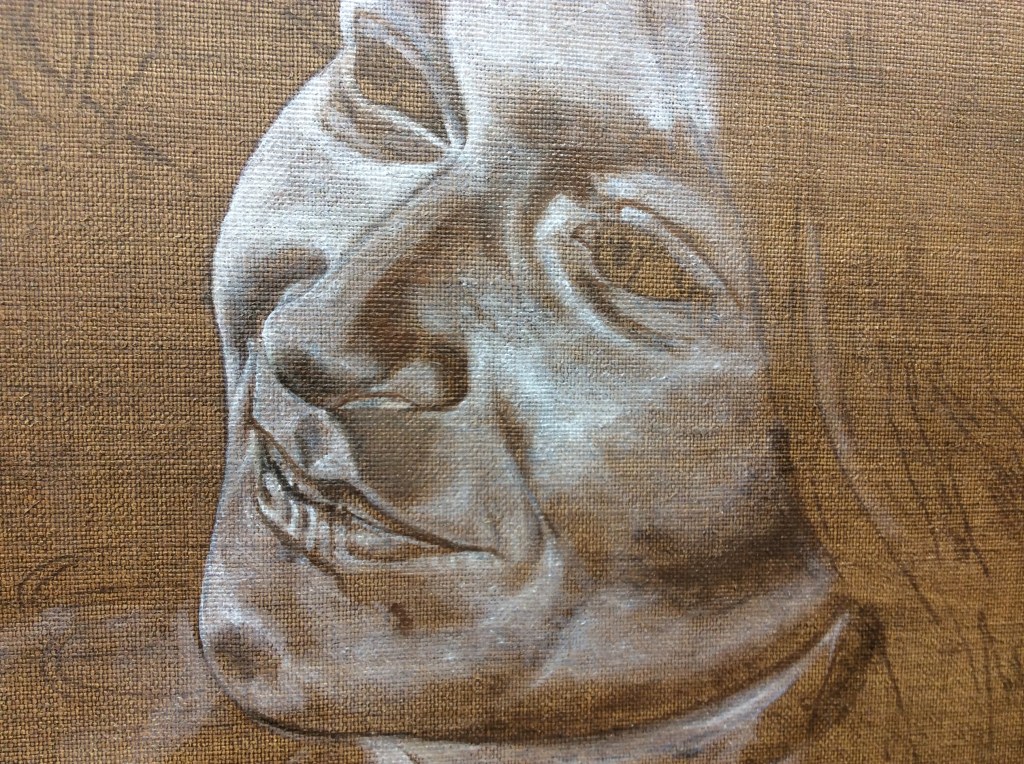
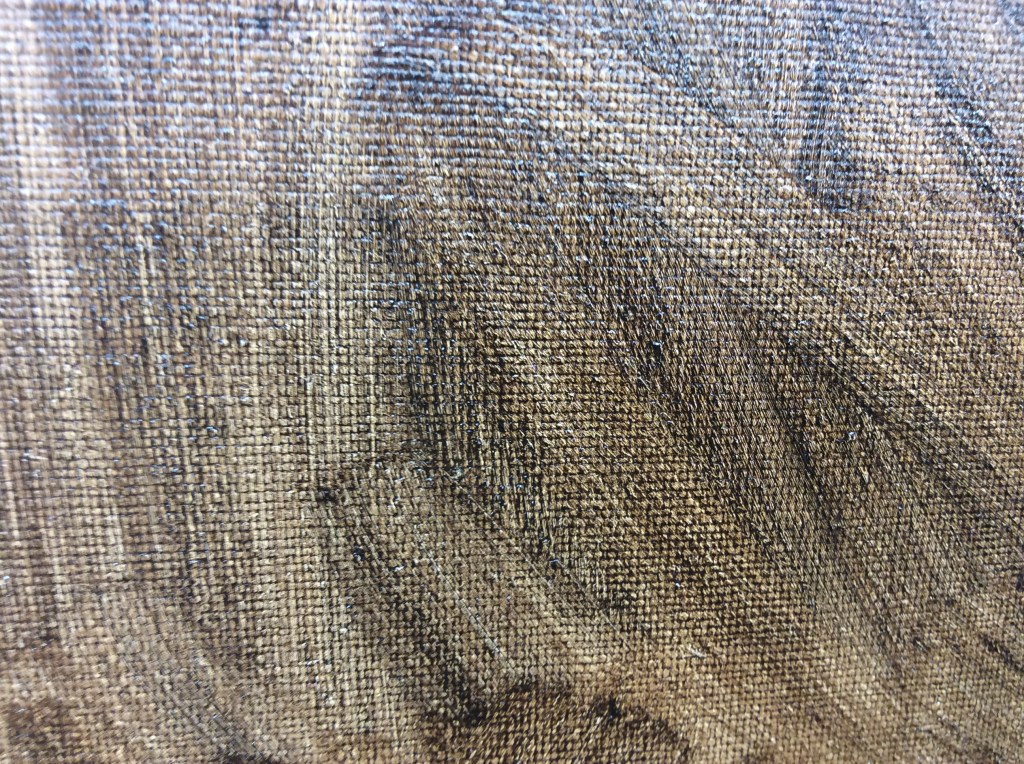
Here is a close up of the transfer of sketch to canvas that I did yesterday. You can see places where I first marked a shadow with only a scribble, just enough to indicate where a structure of the face is. I then used a small sable brush to move that scribble until it becomes a smudge which now looks more like a structural shape than a scribble. It is alright to dip into the same neutral paint in order to refine what you are putting on the canvas. Just be sure to understand that these marks are going to end up under other layers of paint. They will act like a skeleton to form the features which describe a specific person. Today, I could darken some other features so they don’t get obscured by the next layers but I think I will have enough control if I leave them the way they are right now and instead I will work on the brights. When I teach, I like to have students pull out the brightest brights first. Since I am demonstrating my work and actually not following the beginner process, I will start with a half paste and then do the brights. Hopefully, I will get an image which shows the process well. You need to know that I do not use most of the usual mediums. I use Grumbacher Gel, a transparentizer. I will mix flake white (or Titanium) together half and half to make a half paste. Today I want this more transparent so I will use more gel. Now I use a medium sized brush to cover all the flesh area. When this is finished, I buff it to a smooth and glossy surface with a good, soft but firm, fan brush.
Standard
Blog

Transferring the sketch

Here you see a piece of tracing paper that also shows the application of the same color paint as previously used to coat the canvas. Remember, the canvas is now a little lighter because it was wiped down to a medium value. I apply the paint with the pallet knife in the same manner but now I use a soft brush to spread it. If too much paint is left on this tracing paper there will be smudges and spots of paint all over the sketch. It takes a little practice to get it right. In the next photo you will see how I place this paint side down and trace the image onto the canvas.
Standard
Blog

The sketch

Graphing a sketch

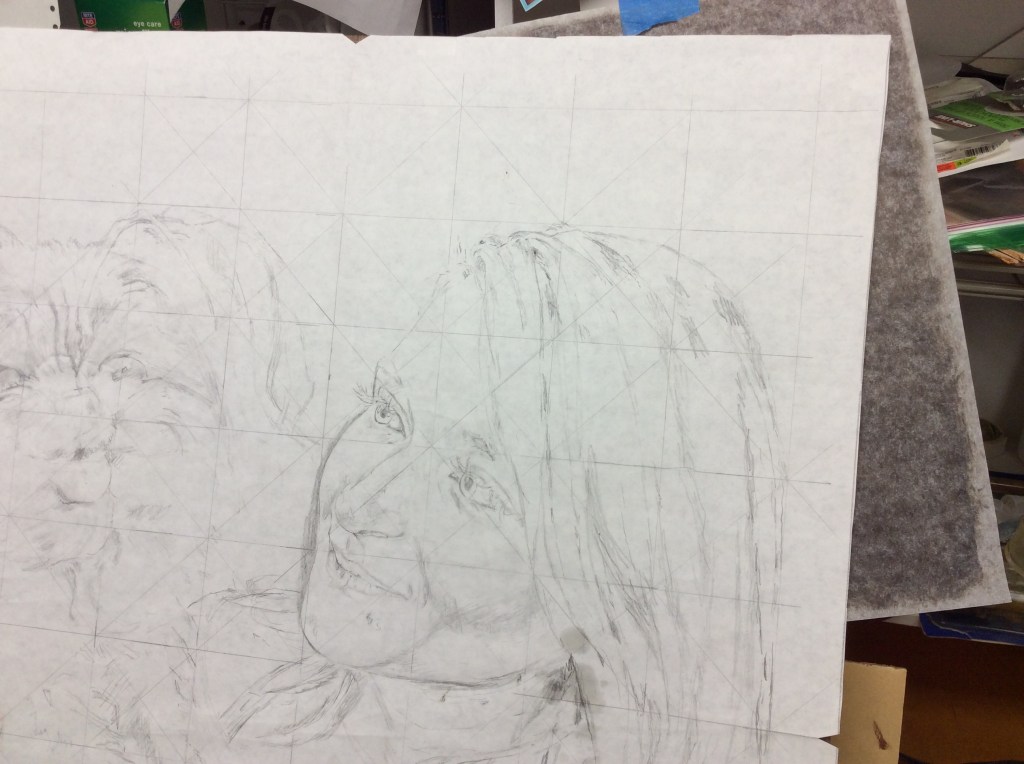
If you have drawn a small sketch and want the painting to be larger, or if you have a small photo and want to make a larger sketch to paint, then you should learn how to do a graph or grid for this purpose. You can find videos and explanations of how to do this on the internet. I will tell you the basics. Always start by finding the center. Find the middle from the long and short sides and draw a straight line both ways on the photo or sketch. Where they cross will be the center. Precisely measure one inch from these lines and add more lines in a checkerboard fashion, being sure to always double check the measurements. Now decide how big you want your final painting to be and make the distance between the lines increase by the correct amount. For instance, if your sketch is 8×10 and you want your painting to be 16×20, then the distance from one line to the other will be two inches instead of the one inch you started with. You can see that I also connect the diagonals too.

Now look at your original photo or sketch. Starting with any feature, draw on the larger graph a mark in a square or triangle that exactly matches the smaller one, just remember to make it the increased size. If you are careful to follow the pattern and not confuse the placement of your marks, then you proportions and likeness should be good.
Standard
Blog

Wiping down the under coat.

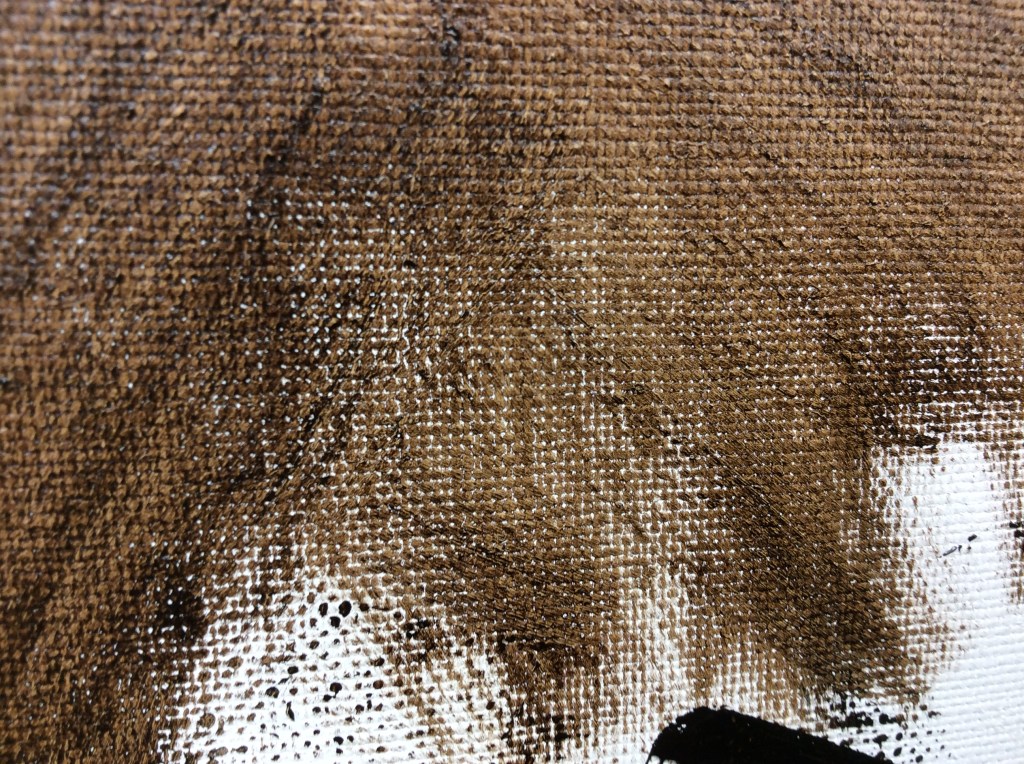
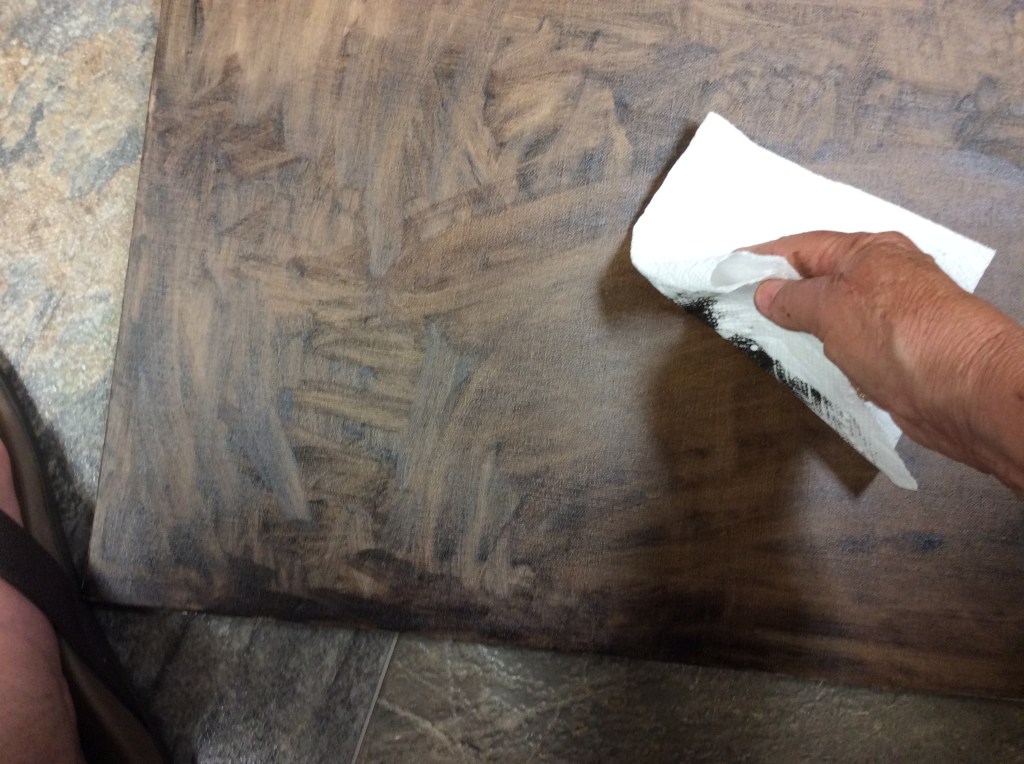
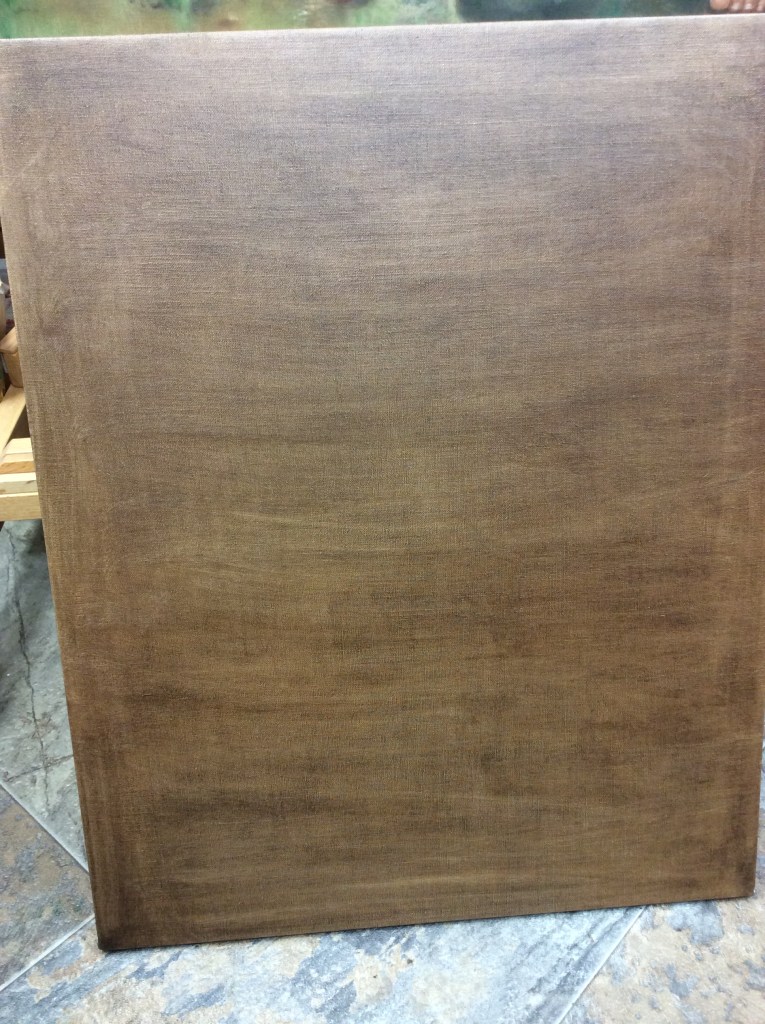
I used paper towels to wipe the paint until it is fairly even and the degree of value, light or dark, that I choose. As you do more, you will learn what you like best and also you will become familiar with the results each value and color will produce as you proceed through the portrait.
next we will use the same paint mixture, burnt umber and French ultramarine blue, to transfer the sketch. In my next blog I will talk about the sketch, a little about how I use a grid to achieve correct drawing, and about the transfer process. Keep in mind, all the colors and methods can be modified. I don’t give you rules, only helpful suggestions.
Standard
Blog

Getting back to work. I won’t bother you with the details except to say one of the things in my life that I am trying to get under control is the garden. Since my creativity with art seems to have been attacked I decided to put some energy into the garden till this other stuff clears up. With the help of my neighbor’s teen nephew the garden is in pretty good shape other than being under water off and on all spring. If Bruce can get his veggie garden plowed before the next deluge we might get to eat some fresh veggies eventually.

The bold type was annoying me and I guess it will post that all as the title.🤪 Now, for those of you who don’t know how to pre coat a canvas for a portrait, I will download some photos to show you how I do it. I mix burnt umber and French ultra marine till I get the degree of gray/brown that I want. As you will see in the photos that I will post, I apply this mixture with an even covering, being sure to fill in all the white.

I will download the photos tomorrow so you can check this then. I just want you to know that I am going to try to keep you posted on the progress of my next painting. If you watch carefully and read the blog, you should be able to learn a lot about my process. Shalom.

.

Standard